H.Sinan Sensoy!
This name will be familiar to anyone who has a history in the sector. Sinan Şensoy is the owner of Matüsan, the first company to operate the once-legendary Vize Pink quarry. Master Interior Architect and at the same time Industrial Designer Sinan Şensoy, by taking an innovative initiative, had made cutting with diamond wire in his Vize Pink quarry. This was one of the first operations of this type at its time.
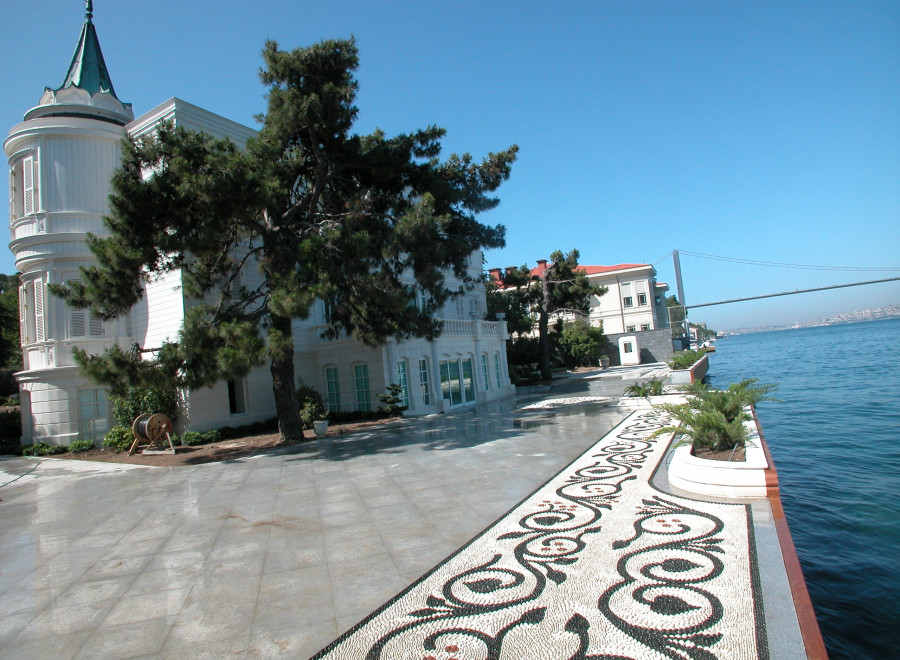
Sinan Şensoy, who started his Artistic Pebble Mosaic "Podima" business as a hobby in 1992, after transferring the Vize Pink quarry in the mid-1990s, became professional. He managed to keep this tradition alive for thousands of years and gained a worldwide reputation.
.jpg)
We asked Sinan Şensoy about Matüsan and Podima Flooring, which comes from a 5,000-year-old tradition, Here are the answers…
“Matüsan is a family company established in 1983 which mainly operated in open quarry mining. The company opened the Vize Pink slim crystal marble quarry, which had been operated in the Roman, Byzantine and early Ottoman periods, in Vize district of Kırklareli for the first time during the Republican Period Turkey. Matüsan was also the first to apply diamond wire cutting technology in Turkey at that period. The world's best Medium Crystal White Marble Block was mined from the Manyas Snow White quarry, which Matüsan first put into operation, and the quarries still continue to produce blocks with the partnership of Sarıkaya & Metamar. Artistic Pebble Mosaic and Podima Flooring Works which started as a hobby in 1992, gained momentum when I met Painter and Sculptor Mehmet Işıklı, whom I respect much. With our ever-growing and developing works after this stage, Matusan has become a company that performs this art in the most comprehensive way in the world today.”
What are the international operations of Matüsan, which has carried out many artistic Pebble Mosaic projects in Turkey?
Matüsan has carried out many prestigious projects in Turkey as well as around the world and continues its activities in Pebble Mosaic projects. The largest mosaic ever made in human history is 1050 square meters. 12,700 square meters of Artistic Pebble Mosaic, Podima Flooring was completed in Turkmenistan Ashgabat Palace with the support of Matüsan.
The first pebble mosaic applications in the world
Vertical Pebble Mosaic on Net, Podima Flooring was first discovered, manufactured and applied by Matüsan. Sliced Pebble Mosaic on FLAT Net, Podima Flooring was discovered, manufactured and applied for the first time in the world by Matüsan.
The first example of pebble mosaic art
The beginning of Mosaic Art dates back to the surfaces made of small terracotta conical pieces on the walls of the Uruk Palace, an ancient Sumerian city in the early 3000 BC. The flooring made with pebbles, which is thought to have been collected from the Euphrates and Tigris rivers, on the platform on which the Persepolis palace was later built, is considered the first example of Pebble Mosaic art. Later, this art can be found in Gordion, Assos, Teos, Erytrai, Tarsus and Bergama, respectively. One of the most beautiful examples of pebble mosaic art from ancient times was unearthed during excavations in Olynthos in northern Greece in IV. Century BC. It depicts Bellerophon's slaying of the Dragon Chimera.
.jpg)
The best-preserved examples to date
The pebble mosaic floor pavement depicting the lion hunt of Dionysus, made with colored pebbles in Pella, Macedonia in the 4th century BC, is the best-preserved example to date. One of the most beautiful examples of Pebble Mosaics preserved until today is the Topkapi Palace Mosaics, which were performed by Greek masters living in the village of Podima (today's Yalıköy), which was the name at that time. Pebble mosaic is a handicraft that has survived to the present day without losing anything from its value as one of the indispensable elements of Mediterranean architecture, in different colors and forms depending on the variety of materials in the region, especially since the beginning of the 18th century.
Pebble Mosaic art in public language
- Pebble mosaic art is also known as podima flooring, pebble inlay, Rhodes decoration, Karfato, nailing in public language
- All the stones used in the pebble mosaic art are in natural forms and colors, and they are collected and arranged one by one as it was in the past 5000 years.
- It has been known for a long time that when a bucket of water is poured on the pebble mosaic, especially at the end of a hot day, the instant air change refreshes people.
- The massaging effect of the pebbles on the soles when you walk on them barefoot is a therapy technique that has been practiced in China for thousands of years. People still walk barefoot on the gravel mosaic road in the big park in Shanghai.
Manufacturing and Application Methods
Traditional on-site application:
- The application spaces are determined in the architectural project and computer-aided pattern design is made. 1/1 molds of the patterns are produced and laid on the application floor, and then the pebbles are arranged one by one by hand. The application depth should be 8 cm from the finished floor. After the hardening process, the tissue is cleaned and the locking paste is applied. The pebbles are collected and placed by the installers one by one by hand. There are 1,300-1,400 pieces of pebbles in one square meter.
Vertical Mesh Pebble Mosaic Application:
- This method is applied by sticking the pebble vertically on the net. The application depth is 3 cm from the finished floor.
Applications on a net: It is preferred in low-profile projects where the application depth is limited, the weight per square meter is expected to be kept to a minimum, or in low quantity projects in very remote areas.
- Vertical pebble mosaic production & application on net was realized by Matüsan for the first time in the world.
FLAT, Sliced Pebble Mosaic Manufacturing & Application:
- FLAT was created by slicing flat and round pebbles in 10mm thickness. It is applied as 30.5x30.5 or 40.6x40.6cm flat or interlock square or border in various sizes.
- In addition to standard productions, personalized artistic productions are also made at the desired project scale.
- The production & application of sliced pebble mosaic on the net was carried out by Matusan for the first time in the world.
OCEANTILE, Horizontal Mesh Pebble Mosaic Manufacturing & Application:
- In this production method, the pebbles selected horizontally according to certain calibration thicknesses are placed on the net by hand in certain mold formats.
- It is collected one by one by hand from the Pacific islands close to the coasts of China, India and Northern Australia, as well as Turkey. Pebbles, whose colors are completely natural, have attained this perfect flat elliptical form over hundreds of years.
- Thanks to the interlock edge finishes, the joint is not visible.. It has two different sizes as 30.5x30.5 and 40.6x40.6cm. It can be applied on horizontal, vertical and inclined surfaces. There are also 10x30, 15x30cm borders.
- Apart from standard production, production and application are also made in project-specific dimensions and patterns.
The Story of the Pebble
Rivers are formed by the collection of water draining from mountains and hills to valleys due to gravity and flow into lakes, seas or oceans at the end of hundreds or even thousands of kilometers.
The rocks on the mountains and slopes at the edges of the valleys where the rivers flow roll into the rivers flowing under the valley due to erosion caused by various tectonic events, temperature changes, and heavy rains,
These rocks, which move with the variable flow of water, crash into each other and break into large and small pieces.
Water, the largest corrosive transforms these pieces into round-faced chubby stream stones over a period of up to hundreds of years.
At the end of the road, these stones meet with the sandy coastline consisting of silicon, calcium carbonate and aragonite in river deltas. At this stage, the waves take over the task for the pebble to reach its final form.
Over a long period, waves repeatedly drag the pebbles to the beach and pull them back again. In the motion process, the pebbles in chubby form are sanded due to the frictional movement on the beach and take flat and elliptical forms.
The pebbles used in the pebble mosaic making are selected, collected and placed one by one and placed on the floor. Floors consisting of vegetal or geometric patterns are created according to their colors. As a result, the journey that takes thousands of years turns into a civilization heritage under the name of Pebble Mosaic Art.
- Where do you supply the stones you use in your projects? How do you collect them? How do you separate the collected stones according to color and size?
The Natural Pebbles that we use in our projects and productions are collected by the people living in the coastal areas in various regions of Turkey. In addition to these, we have varieties that we import from countries such as China and India, especially the Pacific Islands. Different colors and sizes of pebble are collected one by one by hand in line with our discipline. First stage is the collection of pebbles from each region. The next stage is carried out in the warehouse and application fields.
-Can you find all the colors in nature?
Natural Pebbles reflect their texture and color characteristics, depending on the variety and color of the rocks located on the edges of riverbeds, as stated in the story. In addition to their color and form, their components are the same as the rocks. Many pebbles of varying tonalities in white, cream, beige, yellow cotta, red, green, gray and black are used in this art.